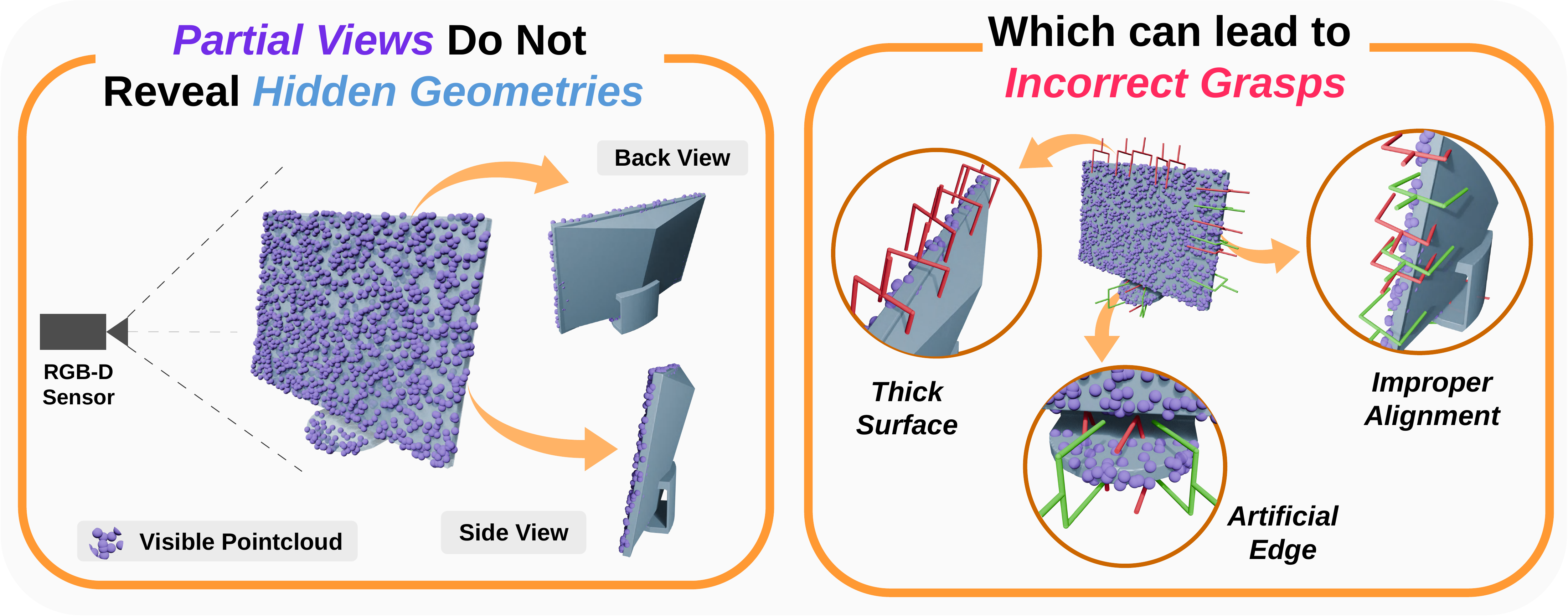
Dual-arm robotic grasping is essential for manipulating large, heavy, and geometrically complex objects that cannot be reliably handled using a single manipulator. These large objects often contain only sparse graspable regions determined by local geometric properties such as thickness, edge structure, and gripper clearance. Prior bimanual grasping methods assume access to a full point cloud of the object which inherently contains this geometric information, but may not be accessible in real scenarios. This work proposes PartialBiGrasp, a dual-arm grasp generation framework that operates directly on partial point cloud observations. Our model learns geometric features implicitly through convolutional occupancy networks, enabling local reasoning about graspability, collision-free contact regions, and object thickness. We leverage this understanding to generate force-closure compliant grasp pairs, which are further refined using a sampling-based optimization to correct for ambiguity caused by incomplete geometry. We evaluate our approach using analytical force-closure metrics, large-scale simulation experiments, and real-world testing on noisy point clouds of novel objects, demonstrating robust and physically stable dual-arm grasp generation for large-object manipulation under partial observations.
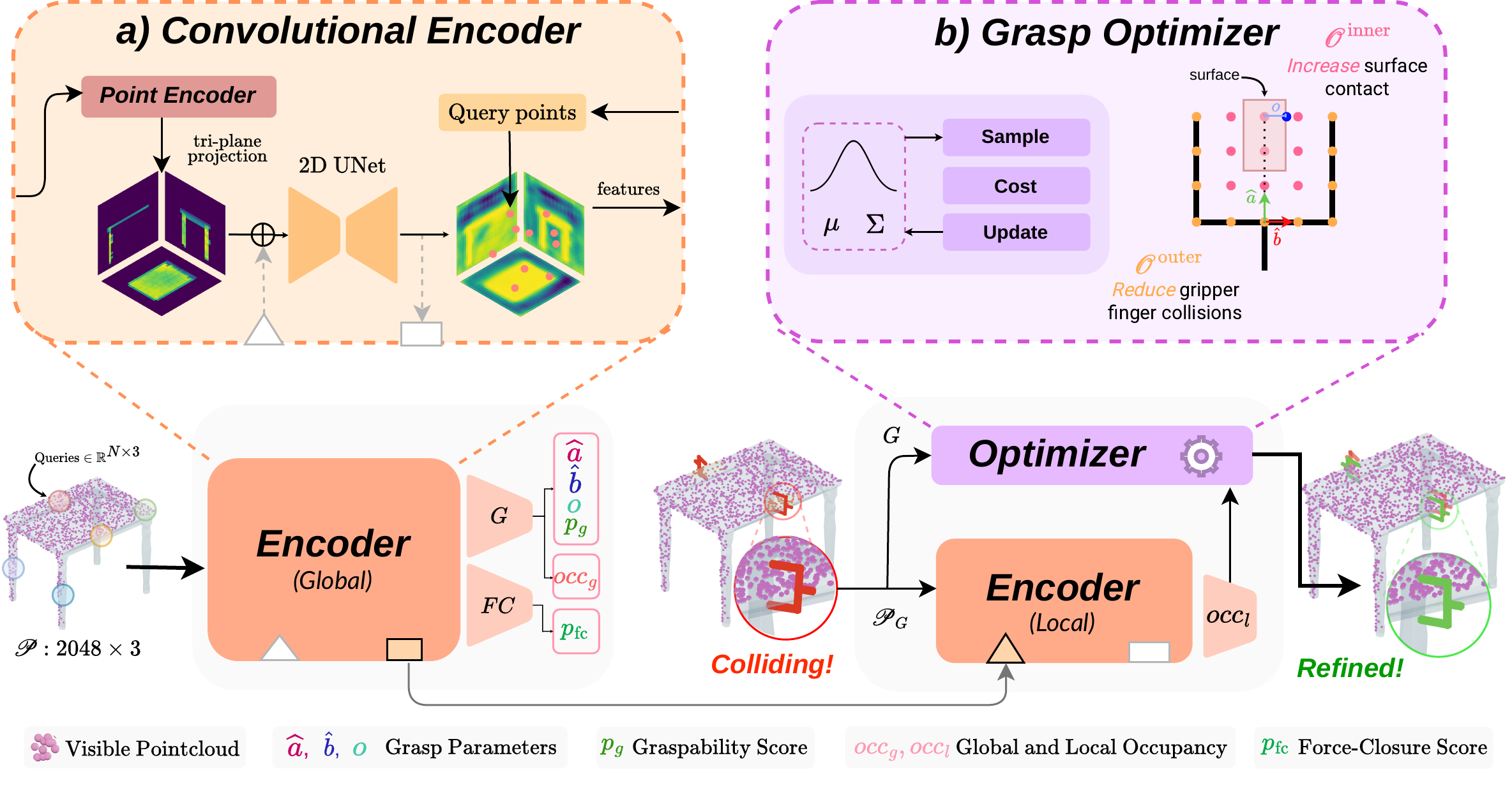
Figure 2. Given a partial point cloud P, the Global Encoder produces a continuous object representation from which the Grasp Generation Module (G) predicts candidate single-arm grasps. High-graspability candidates are paired and scored by the Force Closure Module (FC) to identify analytically stable grasp pairs. Local geometry is captured by encoding gripper-frame point cloud crops (PG) with the Local Encoder. Finally, a sampling-based optimizer uses local occupancy predictions (occl) to reduce collisions and improve contact quality, yielding force-closure-stable grasp pairs that are aware of hidden local geometry.
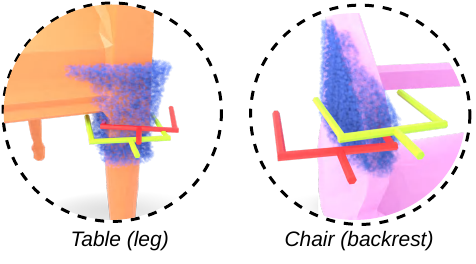
Figure 3. Applied after grasp pairing, Local Occupancy Guided Refinement reasons about hidden local geometry, including thickness and surface continuation under occlusion, to update grasp poses in local regions. The resulting grasps exhibit fewer collisions while preserving the force-closure stability of the grasp pair. Red denotes the initial pose and green denotes the refined pose.
Comparison of baselines on evaluation datasets (▲ Higher is better • ▼ Lower is better)
| Method | FC (%) ▲ | GS (%) ▲ | PC (%) ▼ | Cov. ▲ |
|---|---|---|---|---|
| ContactGraspNet + Attention Pairing | 21.10 | 52.14 | 47.41 | 10.11 |
| ContactGraspNet + Classifier Pairing | 15.03 | 50.05 | 63.44 | 9.42 |
| DAGDiff (Partial) | 22.35 | 46.63 | 49.19 | 14.48 |
| Ours | 55.16 | 67.87 | 17.48 | 16.96 |
| Method | FC (%) ▲ | GS (%) ▲ | PC (%) ▼ |
|---|---|---|---|
| ContactGraspNet + Attention Pairing | 22.56 | 65.04 | 57.15 |
| ContactGraspNet + Classifier Pairing | 22.22 | 62.60 | 63.44 |
| DAGDiff (Partial) | 17.47 | 62.47 | 59.27 |
| RecGen + DAGDiff (Full) | 20.51 | 64.33 | 53.20 |
| Single GraspGen + VLM | 22.96 | 66.93 | 50.16 |
| Ours | 51.06 | 81.54 | 38.80 |
Baselines. ContactGraspNet variants generate single-arm grasps and pair them using either attention-based or classifier-based pairing. DAGDiff (Partial) is trained directly on partial observations, while RecGen + DAGDiff reconstructs complete geometry using RecGen before applying DAGDiff trained on full object point clouds. Single GraspGen + VLM generates candidate single-arm grasps and performs grasp pairing using VLM-predicted grasp regions.
Metrics and Benchmarks. We evaluate all methods on DG16M and a real-world dataset consisting of 11 large everyday objects captured from multiple viewpoints using an Intel RealSense D455 camera, each having a corresponding ground-truth mesh. Metrics include Force Closure (FC), which measures the analytical stability of predicted grasp pairs, Grasp Success Rate (GS), which measures successful object lifting in simulation, Pair Collision Rate (PC), which quantifies collisions between predicted grasp pairs and the object geometry, and Coverage (Cov.), which measures how well successful force-closure grasp pairs span the object's graspable regions. Our method consistently produces higher-quality dual-arm grasp pairs across both benchmarks, achieving improved stability, diversity, and collision avoidance. Real-world demonstrations indicate effective transfer from simulation to physical robot execution on previously unseen objects.